


Cooling Tower
Anyda is experienced in all phases of cooling tower technologies over the past . Since foundation, we have continued in this tradition, challenging existing techniques and technology to meet the specific and more demanding requirements for higher efficiency and higher performance cooling towers.

01
Long Standing Relationships
Trust is the foundation of all relationships. We earn our client’s trust with consistent delivery of excellent service and intelligent, personable interaction.
02
Timely Communication
We deliver a steady flow of updates combined with mindfully responsive answers to client questions. Our goal is to preempt the ask.
03
Cost Effective Services
Quality, fair value, and predictability- these are the cornerstones of our billing philosophy.
04
Commitment to Excellence
Apparent in the way we handle our cases from start to finish, our clients appreciate our personable, experienced, and readily available attorney and staff.
-
 Closed Water Circuit Cooling TowerClosed Circuit Type Cooling Tower Features:. 1.Clean and Contaminant-free. 2.Long Service Life,. 3.Easy Operation & Maintenance, . 4.Low Energy Loss Rate.Add to Inquiry
 -
 Counter Flow Square Cooling Tower1. Cooling Capacity: 8000000kcal/hr. 2. Water Inlet/ Water Outlet: 43Deg/ 35Deg. 3. Water Flow: 450m3/h. 4. Air Volume: 18000m3/hr.Add to Inquiry
 -
 Industrial Cooling Tower System1.Low noise. 2.Energy Conservation. 3.Water Conservation. 4.Stable Cooling Effect. 5.Less MaintenanceAdd to Inquiry
 -
 Cooling Tower Chilled Water SystemCooling Tower Chilled Water System . 1. High quality frame . 2. Durable FRP casing . 3. Long lifetime use parts like knot, sst float valve and so on.Add to Inquiry
 -
 High Temperature Counter Flow Water TowerHigh Temperature Counter Flow Cooling Water Tower Features 1. PP film2. High durable FRP casing3. Durable parts like nylon knot, sst float valve, pp distribution water pipeAdd to Inquiry
 -
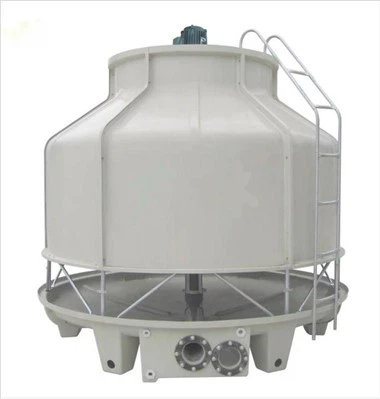 Counter Flow Water Cooling Water Tower 100Ton1. Cooling Capacity: 390,600 kcal/hr. 2. Water Flow: 78 m3/hr. 3. Inlet/ Outlet Temperature: 37/32 Degrees. 4. Wet Bulb Temperature: 28 Degrees.Add to Inquiry
 -
 80T Counter Flow Round Cooling TowerRound Type Cross Flow Cooling Water Tower Special features 1. Copper wire motor2. High durable FRP casing3. Durable parts like nylon knot, sst float valve, pp distribution water pipeAdd to Inquiry
 -
 300T Cross Flow Square Cooling Tower1.Cooling Capacity: 1500000kcal/hr. 2.Water Flow: 300 m3/hr. 3.Wet Bulb Temp: 28 Degs. 4.Temp Inlet/Outlet: 37Degs/ 32Deges. 5.Air Volume: 213000 m3/hr.Add to Inquiry
 -
 400T Cross Flow Cooling Water Tower1.High hardness frame. 2.High durable casing. 3.PVC honeycomb film which make more heat exchange area. 4.Copper core motor which make longer using life.Add to Inquiry

- Tel: +86-755-84074988
- Fax: 86-755-89260199
- Email: info@aydzl.com
- Add: NO.1 jilongshan industrial park, pingdi street
What Is a Cooling Tower?
A cooling tower is a heat rejection device that extracts waste heat from water and releases it into the atmosphere, effectively cooling the water for reuse or disposal.

How does a cooling tower work?
Most cooling towers work based on the principle of “evaporative cooling“.
What is Evaporative Cooling? Evaporative cooling is the process where warm water from an industrial process is pumped up to the top of the cooling tower where the water distribution system is. The water then gets distributed by cooling tower nozzles to the wet deck. At the same time, air is being drawn through the air-inlet louvers forcing water to evaporate. Evaporation causes the heat to be removed from the make up water. The hot air naturally rises out of the tire
Types of Cooling Towers
Open type cooling tower:
An open cooling tower is a heat exchanger that in order to cool down water makes use of the direct contact with the air. The heat transfer occurs partially thanks to a heat exchange between air and water, but mainly thanks to the evaporation of a small quantity of the water that needs to be cooled.
These tend to be one of the most popular styles because they are cost-effective and will achieve the most possible cooling. Heat transfer is measured by way of a decrease in the process temperature and the wet bulb temperature, and how cold the water temperature becomes.
Counter flow cooling towers are designed so that air flows vertically upward, counter to the flow of falling water in the fill.
Because of this vertical airflow, it is not possible to use the open, gravity-flow basins typical in cross flow designs. Instead, counter flow towers use pressurized, pipe-type spray systems to spray water onto the top of the fill.
Since air must be able to pass through the spray system, the pipes and nozzles must be farther apart so as not to restrict airflow.

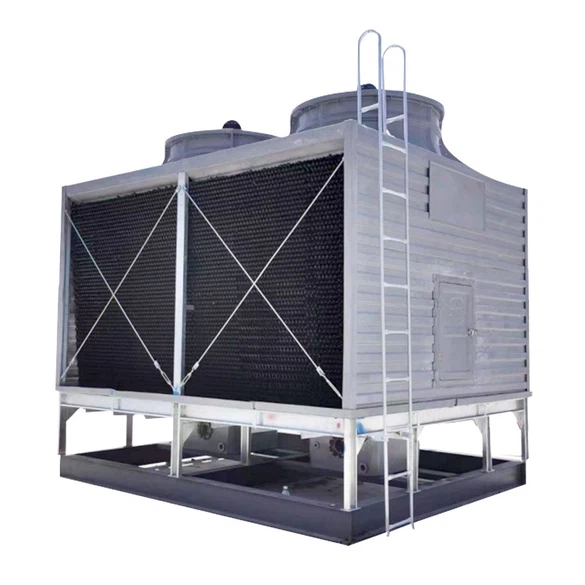
Cross flow
In cross flow cooling towers the water flows vertically through the fill while the air flows horizontally, across the flow of the falling water.
Because of this, air does not have to pass through the distribution system, permitting the use of gravity flow hot water distribution basins mounted at the top of the unit above the fill.
These basins are universally applied on all cross flow towers.
Closed Type Cooling Tower
A closed circuit cooling tower, involves no contact between the air and the fluid being cooled. This tower has two separate fluid circuits, one in which the fluid is recirculated on the outside of the second circuit, which is a bundle of tubes through which the hot water is flowing.
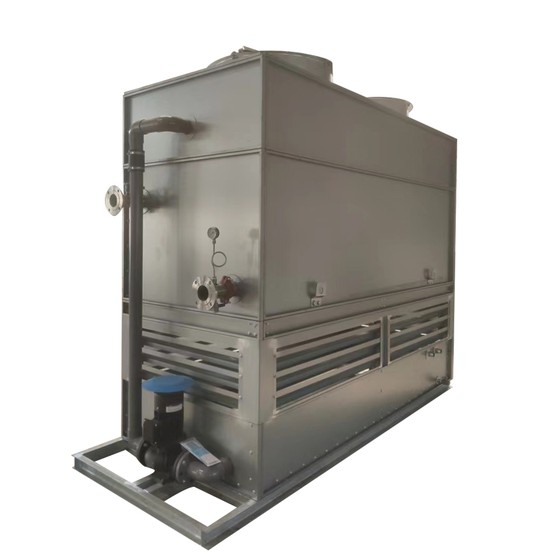
How to choose the Right cooling towers?
When planning and designing a cooling tower system, several factors must be considered:
01
Heat Load
The amount of heat that needs to be dissipated by the cooling tower. This is determined by the industrial process and the equipment involved.
Water flow rate: The rate at which water needs to be cooled and recirculated. This is influenced by the heat load and the desired temperature drop.
02
Water Quality
The chemical composition and purity of the water being cooled. Poor water quality can lead to scaling, corrosion, and biological growth, which can impair the tower’s performance and lifespan.
03
Wet Bulb Temperature
The wet bulb temperature is essential in the design and dimensions of a cooling tower because water in the tower is cooled by evaporation to temperatures lower than the ambient temperature and which therefore approaches a wet bulb temperature. It's an essential when calculating cooling tower water efficiency.

projects

Round Type Cooling Tower
Electroplating Industry
Cross Flow Cooling Tower
Electroplating Industry

Closed Type Cooling Tower
Food Process Industry

Counter Flow Cooling tower
Welding Engineering

why Choose Us
Anyda Refrigeration is working as a renowed cooling tower manufacturer and supplier in China with worldside fame and credential for over 15years.
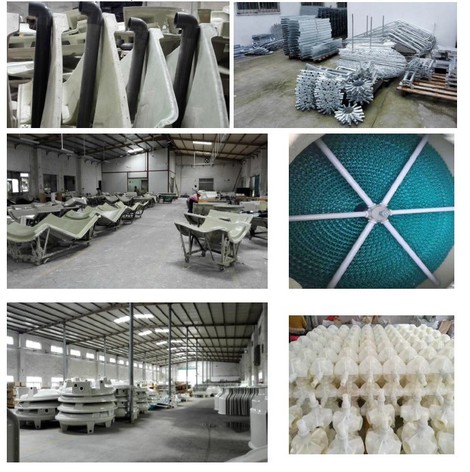
All the parts of the cooling tower are carefully qualified and selected to ensure ‘best value’ to customers and end users alike.
Rich Experience
More than 15 years experience in manufacturing and developing.
Top Quality Control
We have our own the advanced and complete inspection equipment,which can ensure the quality of the cooling towers.
Timely Communication
We deliver a steady flow of updates combined with mindfully responsive answers to client questions. Our goal is to preempt the ask.
Commitment to Excellence
Apparent in the way we handle our cases from start to finish, our clients appreciate our personable, experienced, and readily available attorney and staff.
FAQ
01.What is the advantage of cooling tower?
02.How do I choose a cooling tower for a chiller?
03.What is the difference between dry cooler and cooling tower?
04.Why cooling tower capacity is higher than chiller?
05.What is the best material for a cooling tower?
06.What is the HS code of the cooling tower?
ANYDA is well acknowledged as one of the leading manufacturers of cooling tower in China. All of the cooling tower products for sale are made in our professional plant. Should you're interested in it, please be free to get the high-tech equipment with competitive price from us.
