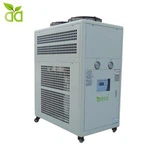
High temperature cooling tower, which means that it can reduce a very high temperature and the temperature difference is large.
Generally, the civilian cooling tower is lowered by 5°C, such as 37° to 32°. This cooling tower can be called a low temperature drop cooling tower.
For industrial use, the temperature difference often reaches 10° or more than 10°. For example, the inlet water temperature is 70° and the outlet water temperature is 35°. The cooling tower that needs to be used is the high temperature cooling tower!
What is a high temperature cooling tower? According to the definition of a high temperature cooling tower in the national standard "Glass Fiber Reinforced Plastic Cooling Tower", that is, a temperature difference of 5°C (37~32°C) is an ordinary cooling tower, and a temperature difference of 10°C (43~33°C) is a medium temperature. Cooling tower, 25°C temperature difference (60~35°C) is a high temperature cooling tower.
High-temperature cooling towers have high requirements, both from the resin used in the manufacture of the FRP tower body and from the filler used in the tower. The resin generally adopts high temperature resistance type, and the filler generally adopts polypropylene (ie PP). Only in this way can the overall high temperature resistance requirements be met.
50T High Temperature Counter Flow Cooling Tower Spec:
Item | Content | Value | Remarks |
Basic specs | Cooling Tower Type | Counter flow round type tower | |
Model | AYD-50T | ||
Circulating Water Flow | 15 m3/h | ||
Inlet Temp/Outlet Temp | 70℃/35℃ | ||
DB/WB | 31.5℃/27℃ | ||
Cooling Capacity | 175,000 kcal/h | ||
Noise Value | 58.5dB(A) | ||
Power Supply | 380V/3P/50Hz | ||
Water Requirement | PH=6-8 | ||
Design specs | Air Water Scale | 0.61kg/kg | |
Flying Water Loss | ≤0.015% | ||
Evaporation Loss | 0.833% | ||
Net/Running Weight | 190/975KG | ||
Motor fan specs | Fan Type | Axial-Flow | |
Air Volume | 21,000m3/h | ||
RPM | 720r/min | ||
Fan Dia(Φ) | 930 mm | ||
Quantity of Fan | 1set | 4pcs/set | |
Driving Mode | Directly | ||
Motor Power | 1.5kW | ||
Start Way | Directly | ||
Main | Inlet Pipe Size(DN) | 80mm | |
Dimension | Outlet Pipe Size(DN) | 80mm | |
Overflow/Drain Pipe(DN) | 25mm/25mm | ||
auto/manual supply(DN) | 15mm | ||
Material | Rotor | P.P | |
Sprinkler System | P.P | ||
Boarding | FRP | ||
Basin | FRP | ||
Fan | NYLON | ||
Air Inlet | P.V.C | ||
Film | P.P |
The cooling tower is exposed to the outside for many years, and the adsorption force of the fan is very strong, so that a large amount of sediment and dirt enter the tower. Long-term operation will slowly reduce the cooling tower's heat dissipation capacity, and the water outlet holes of the water distributor are easily blocked, and the mud Sand and dirt can also easily enter the cooling water system, which will directly affect the normal cooling of the cooling water system. In order to prevent the above situation from happening, the cooling tower must be cleaned regularly.
Cooling tower cleaning treatment plan process
Option 1: Shutdown for cleaning
That is, according to the cleaning process, sterilization and algae killing cleaning - cleaning and descaling cleaning - pre-filming - cleaning after cleaning. This solution needs to be cleaned for about 8 days in a shutdown state, and the descaling rate is over 95%.
Cleaning procedure: water rinse - sterilization and algae killing cleaning - cleaning agent descaling cleaning - rinse after cleaning - pre-membrane - cleaning after cleaning.
1. Rinse with water
The purpose of water flushing is to use a large flow of water to flush out loose dirt such as dust, sediment, shed algae and corrosion in the system as much as possible, and at the same time check the leakage of the system. The flow rate of the flushing water is preferably greater than 0.15m/s, and the flushing water in the system is drained after the flushing is qualified.
2. Sterilization and algae cleaning
The purpose of sterilization and algae cleaning is to kill the microorganisms in the system and to peel off the biological slime attached to the surface of the equipment. After draining the flushing water, add bactericidal and algicide to the system for cleaning, and stop cleaning when the turbidity of the system tends to balance.
3. Cleaning solution for descaling and cleaning
The purpose of cleaning solution is to use the cleaning agent to dissolve the scale and oxide in the system and then dissolve it in water and wash it away. Add the cleaning agent to the central air-conditioning system and use the circulating pump to circulate and clean, and drain at the highest point and the lowest point to avoid air resistance and guide shower blockage, which will affect the cleaning effect. When cleaning, the cleaning solution concentration, metal ion (Fe2+, Fe3+, Cu2+) concentration, temperature, pH value, etc. should be regularly detected, and the cleaning should be terminated when the metal ion concentration tends to be flat.
4. Rinse after cleaning
The purpose of this water flushing is to flush out the remaining cleaning solution and impurities during cleaning. The purpose of flushing is to continuously open the guide shower to flush out the impurities and residual liquid deposited in the short tube. Flushing is to continuously test the pH value and turbidity, and end the flushing when the pH value and turbidity become flat.
5. Pre-film
The purpose of the pre-film is to form a complete corrosion-resistant protective film on the metal surface in an activated state after cleaning or on the metal surface where the protective film is damaged.
6. Cleaning after cleaning
The cooler evaporator is cleaned. After cleaning, the cooler and the evaporator of the main engine should be opened and the cooler should be pulled through and flushed one by one with a special pipe. Because the water circulation system of the cooler is exposed to the atmosphere and the heat exchange temperature is high, the cooler If necessary, the external open circulation system of the cooler should be cleaned and descaled to ensure that every copper tube in the cooler is unblocked. Rinse the evaporator with high-pressure water to thoroughly wash away the impurities precipitated in the evaporator, and if necessary, clean the separate external circulation system of the evaporator.
Cooling tower cleaning, since the cooling tower is exposed to the atmosphere, a large amount of sediment, algae, etc. will adhere to the surface of the cooling tower packing during operation. If it is not cleaned up, the dirt will be flushed into the cooler in subsequent operations, causing cooling The blockage of the heat exchange copper tubes in the device will affect the heat exchange effect, so the cooling tower must be thoroughly cleaned.
Option 2: Non-stop neutral cleaning
When the unit is in normal operation, add neutral cleaning agent to the cooling water and the chilled water system for circulating cleaning for about 30 days. The cleaning time of this solution is relatively long, but it can be carried out under the normal operation of the unit, and will not affect the normal operation of the unit.
Features of Neutral Cleaners:
1. Neutral cleaning without corrosion: the product does not change the PH value of the water after being added to the central air-conditioning water system, and has no corrosion damage to the metal. Corrosive cleaning.
2. High cleaning efficiency: It is effective for various types of scales, especially for insoluble scales such as sulfates that are not cleaned by pickling, and algal biological sludge can also be completely removed. The scale removal rate is over 95%, thereby restoring the original equipment. performance and keep equipment running clean.
3. Simple operation: under the normal startup condition of the central air conditioner, add neutral cleaning agent to the water system and run it for about 30 days, and then discharge the cleaning agent to completely remove all kinds of scale in the water system.
Neutral cleaning principle:
According to the latest theory of coordination field chemistry, under the influence of the electrostatic field of certain ligand compounds, the d orbital of metal ions can split to form orbitals with different energies. When the ligand gives a lone pair of electrons and the central metal element to form O When healthy, if there is an empty π molecular orbital or empty p, d molecular orbital in the ligand molecule, and the symmetry is suitable, the lone pair on the central element d orbital can form a feedback π bond with the ligand, Thereby forming a stable coordination compound.
Based on the above principles, compounds that can cause energy level splitting of Ca2+, Mg2+d orbitals and have π molecular orbitals are selected as π accepting ligands. When this compound interacts with calcium and magnesium scales, it forms stable coordination compounds with Ca2+ and Mg2+d, thereby destroying the molecular structure of calcium and magnesium scales, dissolving them in water, and removing them by sewage.
maintainance
After the cleaning is completed, take chemical maintenance on the cooling water and refrigerant water systems. Corrosion and scale inhibitors are added to the refrigerant water system, which can form stable complexes with various metal ions such as iron, copper and zinc to prevent the corrosion of oxygen and metal ions in the water. Through chelation, inhibition and lattice distortion. It can prevent scaling salts from forming scale in water. So as to play the role of corrosion and scale inhibition. Adding bactericidal and algaecide to the cooling water, because the cooling water system is in an open state, bacteria and algae will be produced during the recycling process.
Hot Tags: high temperature counter flow water tower China, manufacturers, plant, price, for sale