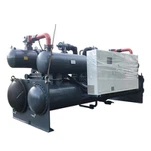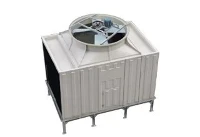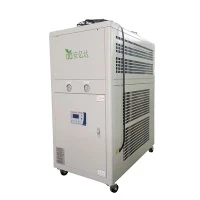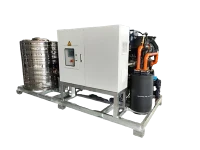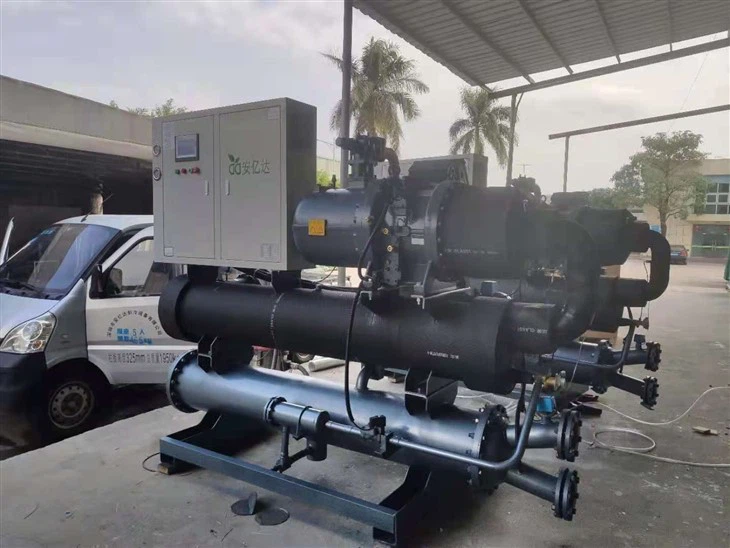

Industrial water chiller efficiency refers to the ability of an industrial chiller system to effectively and economically provide cooling while minimizing energy consumption and operating costs. Chillers are used in various industries to remove heat from processes and equipment, and they can be a significant contributor to energy consumption within a facility. Improving chiller efficiency can lead to cost savings, reduced environmental impact, and improved overall system performance.
Here are some key factors that contribute to industrial chiller efficiency:
1. Chiller Type and Technology: Different types of chillers, such as absorption chillers, centrifugal chillers, and reciprocating chillers, have varying efficiency levels. Newer technologies like variable-speed drives and high-efficiency compressors can significantly improve chiller performance.

Normally water cooled chiller is higher efficiency than air cooled:
|
Item |
Specification / Supplier |
||
|
Cooling capacity |
Model |
AYD-120WS |
|
|
kw/hr |
281.1(0C outlet) |
||
|
kw/hr |
221.3(-10C outlet) |
||
|
kw/hr |
114.3(-25C outlet) |
||
|
Power input |
kw |
99.4 |
|
|
Current |
A |
159.7 |
|
|
Power Supply |
380V-3N-50HZ |
||
|
Temp Outlet (℃) |
-25~ 0 |
||
|
refrigerant control |
Expansion valve |
||
|
Refrigeration circle |
1 |
||
|
refrigerant |
R404A |
||
|
Dimension(mm)L*W*H |
3200*1300*1800 |
||
|
Compressor |
style |
Screw |
|
|
Model |
RC-410B |
||
|
Qty |
1 |
||
|
Compressor power(kw) |
99.4 |
||
|
Condenser |
Style |
Shell and Tubes/1set |
|
|
Chilled water flow(m3/h) |
65.45 |
||
|
Pipe size(") |
5 |
||
|
Evaporator |
Style |
Shell and Tubes/1set |
|
|
Cold water flow(m3/h) |
48 |
||
|
Pipe size(") |
4 |
||
|
Protector Device |
1,Phase protector 2,Flow protector 3,High/low voltage protector 4,Coil overheat protector 5,Anti-freeze protector |
||
|
Unit Weight(kg) |
2450 |
||
|
Main Parts Brand |
|||
|
Compressor |
Hanbell |
||
|
Electronic |
LS / Chnt |
||
|
Expansion Valve |
Emerson |
||
|
Electrical Control |
Siemens |
||
2. Load Matching: Matching the chiller's capacity to the actual cooling load is crucial. Oversized or undersized chillers can lead to inefficient operation. Using multiple chillers or a chiller plant with varying capacity stages can help match the load more effectively.

3. Chilled Water Setpoint: Operating the chiller at a higher chilled water temperature setpoint can improve efficiency. However, this needs to be balanced with the cooling requirements of the processes and equipment being cooled.
4. Condenser Water Temperature: Maintaining optimal condenser water temperatures, whether through water-side economizers or optimizing cooling tower operation, can enhance chiller efficiency.
5. Regular Maintenance: Regular maintenance, including cleaning the condenser and evaporator coils, checking refrigerant levels, and ensuring proper lubrication, can help maintain chiller efficiency over time.
6. Controls and Automation: Implementing advanced control strategies and automation systems can optimize chiller operation based on real-time conditions and load variations.
7. Variable-Speed Drives: Using variable-speed drives for the chiller compressor and other components allows the system to adjust its output based on the cooling load, reducing energy waste during partial load conditions.

8. Heat Recovery: Some chiller systems offer heat recovery options, where waste heat from the chiller's cooling process is used for other applications such as space heating or hot water generation.
9. Efficient Design: Properly designing the chiller system layout, piping, and insulation can minimize energy losses and improve overall efficiency.
10. Energy Monitoring and Analysis: Installing energy monitoring systems to track chiller performance and energy consumption can help identify inefficiencies and opportunities for improvement.

11. Chiller Maintenance: Regularly cleaning and maintaining chiller components, such as evaporator and condenser coils, filters, and sensors, can prevent fouling and ensure optimal performance.
12. Chiller Selection: When selecting a new chiller system, considering factors like the Coefficient of Performance (COP), Integrated Part Load Value (IPLV), and Energy Efficiency Ratio (EER) can help you choose a more efficient unit.
Improving industrial water chiller efficiency requires a holistic approach that encompasses both the technical aspects of the chiller system itself and the operational practices of the facility. Regular assessments, upgrades, and adaptations are essential to ensure ongoing efficiency gains.
Hot Tags: industrial water chiller efficiency China, manufacturers, plant, price, for sale