Water Chiller Machine- Overview, Differences between Air-Cooled and Water-Cooled, and Applications
water chillers are critical components of many manufacturing processes, especially for large-scale industries that require cooling solutions to operate efficiently. These chillers are designed to remove heat from various industrial equipment and processes, thereby keeping the temperature of the manufacturing facility at manageable levels.
The two most widely used systems for industrial chillers are air-cooled and water-cooled systems. While every industrial application has its unique cooling requirements, these two types of chillers have certain characteristics that distinguish them.
Air-Cooled Chillers - Features and Advantages
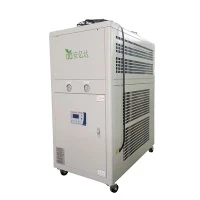
As the name suggests, air-cooled chillers use ambient air to cool and reject heat from the manufacturing process. There are various types of air-cooled chillers, including dry coolers and finned tube heat exchangers.
One of the primary advantages of an air-cooled chiller is its low maintenance cost. There is no need for a cooling tower, and minimal water is used since there is no water evaporation that can occur. This also means that there are no water treatment expenses, and no risk of leaking water that can create hazardous conditions.
Air-cooled chillers also take up less space compared to their water-cooled counterparts, making them ideally suited for installations with limited space. In addition to its space-saving benefits, air-cooled chillers tend to be less costly to install because there is no need for any additional piping to a cooling tower.
Water-Cooled Chillers - Features and Advantages
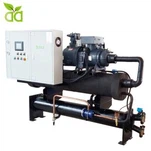
Water-cooled chillers use water as their primary means of cooling and transferring heat away from the industrial process. They are designed with a refrigeration circuit that uses a condenser water loop to absorb heat and a separate chilled water loop to distribute cool water to process equipment.
Water-cooled chillers are more efficient compared to air-cooled models because they are capable of handling a larger cooling load. These chillers are suitable for high-temperature processes and operations where the ambient air temperature is too high to provide enough cooling.
Another benefit of water-cooled chillers is that they function independently of the ambient air temperature. They are not affected by the outside environment, which means they can provide consistent cooling even in changing weather conditions. This consistency also helps maintain product quality, reduce downtime, and extend the lifespan of the cooling equipment and associated components.
Applications of Industrial Chillers
Industrial chillers have a wide range of applications across various industries. From electronics manufacturing to plastics and chemical processing, chillers are an essential component of various applications where consistent and reliable cooling is essential.
Some common applications of industrial chillers include:
- HVAC Systems - Industrial chillers are used to provide chilled water to HVAC systems, which is then circulated through the building to provide cool air.
- Food & Beverage - Industrial chillers are used to cool food and beverage products such as wine, beer, and soft drinks during the manufacturing process.
- Plastics Industry - Chillers are used to maintain a consistent temperature in the production of plastic components, ensuring product quality and reducing defects.
- Medical Industry - Industrial chillers are used in medical equipment such as MRI machines and laser systems.
- Printing - Chillers are necessary in the printing process to maintain consistent ink viscosity and prevent damage to printing plates.
Conclusion
Industrial chillers offer an efficient and reliable cooling solution for various manufacturing processes across different industries. Air-cooled chillers are cost-effective and space-saving, while water-cooled chillers offer superior performance and consistency. The choice of the type of chiller depends on the specific cooling requirements of the application. Overall, an industrial chiller reduces downtime, extends equipment lifespan, and improves product quality, making it a critical component of the manufacturing process.
Here Let's look the 15ton Water Cooled Chiller Machine Cooling Specs:
|
Item |
Specification / Supplier |
||
|
Cooling capacity |
Model |
AYD-15W |
|
|
kw/hr |
53.01 |
||
|
ton/hr |
15.07 |
||
|
Power input |
kw |
15.31 |
|
|
Power Supply |
380V-3N-60HZ |
||
|
Temp Outlet (℃) |
7 |
||
|
refrigerant control |
Expansion valve |
||
|
Refrigeration circle |
Three |
||
|
refrigerant |
R407C |
||
|
Dimension(mm)L*W*H |
1700*800*1300 |
||
|
Compressor |
Style |
Hermetic Scroll |
|
|
Quantity(set) |
3 |
||
|
Compressor Power(kw) |
13.11 |
||
|
Condenser |
Style |
Shell and tubes/1set |
|
|
Water Flow( m3/h ) |
11.6 |
||
|
Pipe size(DN) |
50 |
||
|
Evaporator |
Style |
Shell and Tubes/ 1set |
|
|
Cold water flow(m3/h) |
9.16 |
||
|
Pipe size(DN) |
40 |
||
|
Water Pump(kw) |
2.2(7.2m3/h, 3.3bar) |
||
|
Water Tank(L) |
180 |
||
|
Protector Device |
1.Phase protector 2.Overload protector 3.High/low voltage protector 4.overheat protector 5.Anti-freeze protector |
||
|
Unit Weight(kg) |
400 |
||
|
Main Parts |
|||
|
Compressor |
Sanyo/Panasonic |
||
|
Electronic |
Chnt /LS |
||
|
Electrical control |
Punp |
||
Remarks: The cooling capacity is based on condensing water inlet/outlet temp 32/37C,inlet/outlet temp 12/7C.

Hot Tags: 15 ton water cooled water chiller machine cooling China, manufacturers, plant, price, for sale