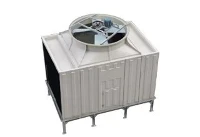
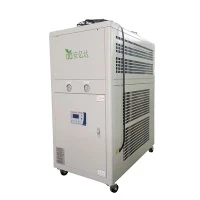
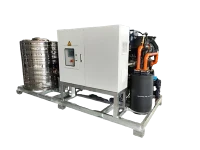
ANYDA is well acknowledged as one of the leading manufacturers of industrial chillers for reactor vessels in China. All of the products for sale are made in our professional plant. Should you're interested in it, please be free to get the high-tech equipment with competitive price from us.
In chemical, pharmaceutical, and biochemical industries, jacketed reactors (or "kettles") are widely used for mixing, synthesis, and formulation. An industrial chiller plays a critical role in these systems by providing precise temperature control.
1. Exothermic Reaction Control
Many chemical reactions generate significant heat (exothermic reactions). If this heat is not removed quickly, it can lead to:
Runaway reactions (uncontrolled temperature spikes).
Decomposition of raw materials.
Safety hazards (pressure buildup or explosions).
The chiller circulates a coolant (such as water, glycol, or specialized thermal fluids) through the jacket surrounding the reactor vessel. This absorbs excess heat instantly, maintaining the reaction temperature at a safe and stable set point.
2. Crystallization and Precipitation
In pharmaceutical manufacturing and fine chemical production, chillers are used to rapidly cool a saturated solution to induce crystallization.
Precise cooling rates (e.g., 0.5°C per minute) are critical for controlling crystal size and purity.
A chiller allows for programmable cooling curves, ensuring product consistency and yield.
3. Condensation and Reflux
When reactors are equipped with condensers, chillers provide cold fluid to the condenser coils. This allows:
Volatile solvents to be condensed and returned to the reactor (reflux).
Solvent recovery without losing material to evaporation.
4. Viscosity Management
Certain materials become highly viscous or solidify at room temperature. A chiller helps maintain the material within an optimal viscosity range during mixing, ensuring uniform blending and preventing damage to the agitator.
5. Pilot Plant vs. Production Scale
Pilot Reactors (10L – 200L): Typically paired with recirculating chillers that offer high accuracy (±0.1°C) for R&D and scale-up studies.
Production Reactors (1,000L – 20,000L): Require large-capacity central chillers or cooling towers to handle the high thermal load, often working in tandem with steam boilers for heating/cooling cycles.
In a reactor system, the chiller acts as the "thermal management system." It ensures that regardless of whether the process requires rapid heat removal, constant low-temperature maintenance, or precise temperature ramping, the chemical reaction occurs safely, efficiently, and with high repeatability.
Selecting the right chiller for a reactor is critical to ensure process safety, product quality, and operational efficiency. Below are the key factors to consider:
1. Cooling Capacity (Heat Load)
The most fundamental parameter is the heat load of the reactor system. This includes:
Exothermic heat generated by the chemical reaction itself
Sensible heat required to cool the batch from an initial temperature to the target temperature
Heat ingress from the environment (jacket, vessel walls, agitation)
Action: Calculate the total heat load (usually in kW or BTU/hr) and select a chiller with at least 10–20% excess capacity to account for scale-up, fouling, and ambient variations.
2. Temperature Range And Control Accuracy
Different reactions require different cooling temperatures:
Standard cooling: 7°C – 25°C (using chilled water)
Low-temperature reactions: -20°C to 0°C (using glycol or brine)
Ultra-low temperature: -40°C or lower (specialized refrigerants)
Additionally, look for:
Temperature control accuracy: Typically ±0.5°C to ±0.1°C for sensitive reactions
Programmable temperature ramping: Allows for controlled cooling curves (e.g., crystallization)
3. Reactor Volume And Jacket Design
The reactor size and heat transfer surface directly affect chiller selection:
Reactor volume (Liters or gallons): Larger volumes require higher flow rates and cooling capacity
Jacket type:
Conventional jacket: Lower heat transfer efficiency, may require higher flow
Dimple jacket / Half-coil jacket: Higher efficiency, can work with lower flow but higher temperature differential
Internal coil: Adds additional heat transfer area, may require dedicated circulation
Key metric: Ensure the chiller's flow rate (L/min or GPM) and pressure head are compatible with the reactor jacket's resistance.
4.Material Compatibility
Reactor processes often involve corrosive chemicals. Ensure the chiller's wetted parts (pump, heat exchanger, piping) are constructed from:
Stainless steel (304 or 316L) for general chemical resistance
Titanium or Hastelloy for highly corrosive applications (e.g., chlorides, strong acids)
Copper-free systems for applications sensitive to copper contamination
Selecting the right chiller for a reactor is not just about matching horsepower - it requires a holistic assessment of process dynamics, safety requirements, automation integration, and long-term reliability.
Here we list the industrial chiller model AYD-20A for our customer:
|
Item |
Specification / Supplier |
||
|
Cooling capacity |
Model |
AYD-20A |
|
|
kw |
35.2 |
||
|
kcal |
30265 |
||
|
Power input |
kw |
18.5 |
|
|
Power Supply |
380V-3N-50HZ |
||
|
Temp Outlet (℃) |
-5 |
||
|
refrigerant control |
Expansion valve |
||
|
Refrigeration circle |
Two | ||
|
refrigerant |
R407C |
||
|
Dimension(mm)L*W*H |
2000*910*1800 |
||
|
Compressor |
Style |
Scroll |
|
|
Quantity(set) |
2 |
||
|
Compressor Power(kw) |
15.24 |
||
|
Condenser |
Style |
Fin type with copper coil |
|
|
Quantity(set) |
2 |
||
|
Power(kw) |
1.7 |
||
|
Air Volume(m3/h) |
21000 |
||
|
Evaporator |
Style |
Shell and Tubes |
|
|
Cold water flow(m3/h) |
6.8 |
||
|
Pipe size(DN) |
40 |
||
|
Water Pump(kw) |
1.5(11m3/h, 2bar) |
||
|
Protector Device |
1.Phase protector 2.Fan overload protector 3.High/low voltage protector 4.overheat protector 5.Anti-freeze protector |
||
|
Unit Weight(kg) |
1280 |
||
|
Main Parts |
|||
|
Compressor |
Sanyo |
||
|
Condenser |
Anyda |
||
|
Evaporator |
Jindian |
||
|
Electronic |
LS/ Chnt |
||
|
Expansion Valve |
Sanhua |
||
|
Pump |
Mina |
||
|
Control System |
Punp |
||
Remarks: The cooling capacity is based on ambient temp 35C, inlet/outlet temp 0/-5C.
20HP Industrial Chiller Detailed Image

Company Information

Company Profile
Shen Zhen Anyda Refrigeration Machinery Co., Ltd. is a high-tech private enterprise which was established in 2013 and is specialized in the research, production and trading of industrial refrigeration technology and facilities. We have gradually produced Industrial Chiller,Water Chiller,Air Cooler,Oil Chiller,Low Temperature Chillers,Hot Water Chiller, Heat Pumps and Central Air Conditioner which are widely applied to plastic & rubber machinery, daily-use chemical, textile, general machinery, laser machinery, LCD and PCB industry, electroplating, equipments of laboratory, food, pharmacy, etc . Now we own more than one hundred staff and about twenty of them are engineers with high grade titles. We gained the certification of ISO9001:2008 and CE international quality management systems. We are looking forward to your suggestion, and are confident of becoming your choice !
FAQ
1.In chemical and pharmaceutical plants,could it be explosion proof type?
Yes, we could make it as EX-proof.
2.Many reactor processes require both heating and cooling in a single cycle, does your chiller could heat and cooling in one unit?
Yes, pls inform heating capacity, hot water temp, cooling capacity, cold water temp required.
3.Does Your Chiller With Communication Protocols?
yes, but it is customized, like Modbus 485 and so on.
4.Where the industrial should be located?
Indoor installation: Requires adequate ventilation and may need remote condenser to dissipate heat
Outdoor installation: Chiller must be weatherproof with appropriate insulation
Hot Tags: industrial chillers for reactor vessels China, manufacturers, plant, price, for sale