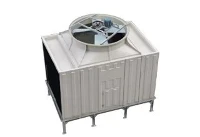
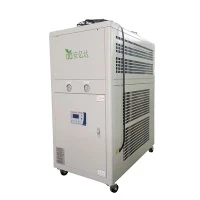
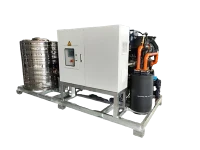
Industrial water chillers are used in a variety of applications where chilled water or liquid are circulated through process equipment. Commonly used to cool products and machinery, water chillers are used in a multitude of different applications including injection molding, tool and die cutting, food and beverage, chemicals, lasers, machine tool, semi-conductors and more.
The function of an industrial chiller is to move heat from one location (usually process equipment or product) to another place (usually the air outside the manufacturing facility). It is very common to use water or a water/glycol solution to transfer the heat to and from the chiller, which may require the process chiller to have a reservoir and pumping system. Regardless of your industry and process, making sure that you have sufficient cooling is critical to productivity and cost savings.
Why use a Chiller ?
Industrial water chillers are a cost-effective and excellent cooling solution suitable for various industrial settings. A properly sized water-cooled chiller system is an asset to every industrial operator looking to maximize productivity while minimizing equipment downtimes. The key advantages of using a water chiller system for process cooling are outlined below.
1. Energy Efficiency
Water chiller-enabled process cooling is a very efficient method for various reasons. To begin with, water chillers operate independently of ambient environmental temperatures, allowing them to avoid system inefficiencies that occur with fluctuations in ambient thermal conditions. Furthermore, due to their principle of operation (using water to dissipate heat from a system), water chillers are very effective in rapidly lowering the temperatures in larger industrial applications.
2. High Return on Investment and Cost and Energy Savings
Among the water chiller benefits is a higher return on investment. While the initial costs of installation and start-up might be significant, once the water chiller system is up and running, it is a worthwhile long-term investment with few maintenance costs and component replacements.
Many process chiller constructors build water chiller systems that significantly save energy costs. The coolant used in these chillers (water) is plentiful, cheap, and easy to source compared to other alternatives. In addition, water is an excellent medium for carrying heat energy, which means it will rapidly dissipate the heat contained within an associated process faster while utilizing less energy.
3. Long-Lasting Process Cooling
Process chiller manufacturers typically build water chiller systems to last for very long. When compared to other cooling systems, water chillers are more durable and have far longer life spans.
The explanation for this is relatively straightforward. Most of the components within water-cooled chiller systems are typically installed indoors, with only a few parts exposed to natural weather elements (rain, wind, sunlight, ice).
4. Increased Production Speed
Water chillers can boost production speed by optimizing process temperatures. Maximum efficiency is obtained under properly regulated thermal conditions, and water-cooled chillers can guarantee a stable process environment. Additionally, water chiller systems prevent damage to heat-sensitive industrial components preventing undesirable repair downtime that might slow or even halt production altogether.
5. Quiet Operation
Process chilling done using water-cooled industrial chillers is a noiseless one. This is another major advantage of using water chillers. They possess few dynamic components and, as such, will not generate unwanted noises in an industrial environment. This will allow their use in virtually any setting with good compliance with industrial noise level regulations.
6. Greater Flexibility
Water chiller systems are very flexible industrial devices that can be modified to operate in various indoor and outdoor settings. Dependent on operator requirements, water-cooled chillers can be manufactured in a vast range of sizes and configurations to ensure maximum process compatibility.
How does a Chiller Work?
In most process cooling applications, a pumping system circulates cool water or a water/glycol solution from the chiller to the process. This cool fluid removes heat from the process and the warm fluid returns to the chiller. The process water is the means by which heat transfers from the process to the chiller.
Process chillers contain a chemical compound, called a refrigerant. There are many types of refrigerant and applications depending on the temperatures required but they all work on the basic principle of compression and phase-change of the refrigerant from a liquid to a gas and back to a liquid. This process of heating and cooling the refrigerant and changing it from a gas to a liquid and back again is the refrigeration cycle.
The refrigeration cycle starts with a low-pressure liquid/gas mix entering the evaporator. In the evaporator, heat from the process water or water/glycol solution boils the refrigerant, which changes it from a low-pressure liquid to a low-pressure gas. The low-pressure gas enters the compressor where it is compressed to high-pressure gas. The high-pressure gas enters the condenser where ambient air or condenser water removes heat to cool it to a high-pressure liquid. The high-pressure liquid travels to the expansion valve, which controls how much liquid refrigerant enters the evaporator, thereby beginning the refrigeration cycle again.
There are two types of condensers used in chillers; air-cooled and water-cooled. An air-cooled condenser uses ambient air to cool and condense the hot refrigerant gas back down to a liquid. It can be located inside the chiller or can be remotely located outside, but ultimately it rejects the heat from the chiller to the air. In a water-cooled condenser, water from a cooling tower cools and condenses the refrigerant.
Water-Cooled Chillers
The most common types of water chillers use water from an external tower to cool the gaseous refrigerant in the condenser. After expelling its heat, the refrigerant undergoes a phase change into a liquid and is recirculated into the system.
The Pros
Water-cooled chillers are generally more efficient than air-cooled chillers
They have a quieter operation than air-cooled systems
They are suitable for both small-scale and commercial-scale cooling
Portable solutions are available for facilities with space constraints
The Cons
Water-cooled chillers can be costly to install and maintain due to the additional cooling water tower, tanks, and water pump
Since they require a constant supply of water for cooling, they might not be suitable for locations with water shortages or restrictions
Water-cooled systems require periodic condenser water treatment to prevent the formation of mineral deposits in the system.
Explore portable, stationary, central and custom water-cooled chillers from Cold Shot Chillers here.
Air-Cooled Chillers
Air-cooled chillers use ambient air to reject heat from the refrigerant in the condenser before condensation and recirculation. Additionally, air fans attached to the unit help speed up the cooling process.
Different Types of Chillers
Air-cooled chillers are suitable for applications where the discharged heat will not be an issue, as they tend to produce a considerable amount of warmth at the site.
The Pros
Portable solutions are available for facilities with space constraints
Air-cooled chillers are available for small-scale and commercial-scale cooling depending on sizing and chiller capacity
They are cheaper to install and maintain than water-cooled systems
The heat ejected from the chiller can be used to warm the facility during cold periods, providing additional cost and power savings.
The Cons
Air-cooled chillers use cooling fans which produce some level of noise
The life expectancy of an air-cooled chiller can be less than that of a water-cooled chiller
Cold Shot Chillers offers a range of top-quality air-cooled chillers of varying sizes and capacities.
Plastic Injection Molding/Extrusion/Bottle Blowing Machine Chiller Detailed Product Description
1. Designed with imported compressor and water pump for ultra-powerful refrigeration, with prolonged service life;
2. High-efficiency evaporator and condenser realizing rapid thermal transfer;
3. Open-type stainless steel water tank, easy and fast to clean and maintain;
4. Double-compressor design to save energy and power;
5. Well-structured safety protection and trouble indication system;
6. Microcomputer touch-type control, accurate temperature control and simple operation.
Item | Specification / Supplier | ||
Cooling capacity | Model | AYD-40W | |
kw | 120 | ||
ton | 34 | ||
Power input | kw | 32 | |
Temp Outlet (℃) | 7 | ||
Power Supply | 380V-3N-50HZ | ||
refrigerant control | Expansion valve | ||
Refrigeration circle | four | ||
refrigerant | R407C | ||
Dimension(mm)L*W*H | 3000*1000*1800 | ||
Compressor | Style | Scroll | |
Quantity(set) | 4 | ||
Compressor Power(kw) | 28 | ||
Condenser | Style | Shell and Tubes / 1set | |
Cold water flow(m3/h) | 26.8 | ||
Pipe size(DN) | 40 | ||
Evaporator | Style | Shell and Tubes / 1set | |
Cold water flow(m3/h) | 22 | ||
Pipe size(DN) | 80 | ||
Pump Power(kw/h) | 4(30m3/h,2.4bar) | ||
Tank Volume(L) | 400 | ||
Protector Device | 1.Phase protector 2.Fan overload protector 3.High/low voltage protector 4.overheat protector 5.Anti-freeze protector | ||
Unit Weight(kg) | 850 | ||
Main Parts | |||
Compressor | Sanyo | ||
Condenser | Anyda | ||
Evaporator | Jindian | ||
Electronic | LS / Carlo | ||
Expansion Valve | Emerson | ||
Electrical control | Punp | ||
Remarks: The cooling capacity is based on condensing temp 40C,inlet/outlet temp 12/7C
.
Safety protection system:
1.No tatal power circuit breaker
2.Compressor overload protection
3.Circulating pump overload protection
4.Anti-phase and open phase protection
5.High&Low pressure protection for refrigerant
6.Freezing protector trouble indicator and abnormality buzzer alarm.
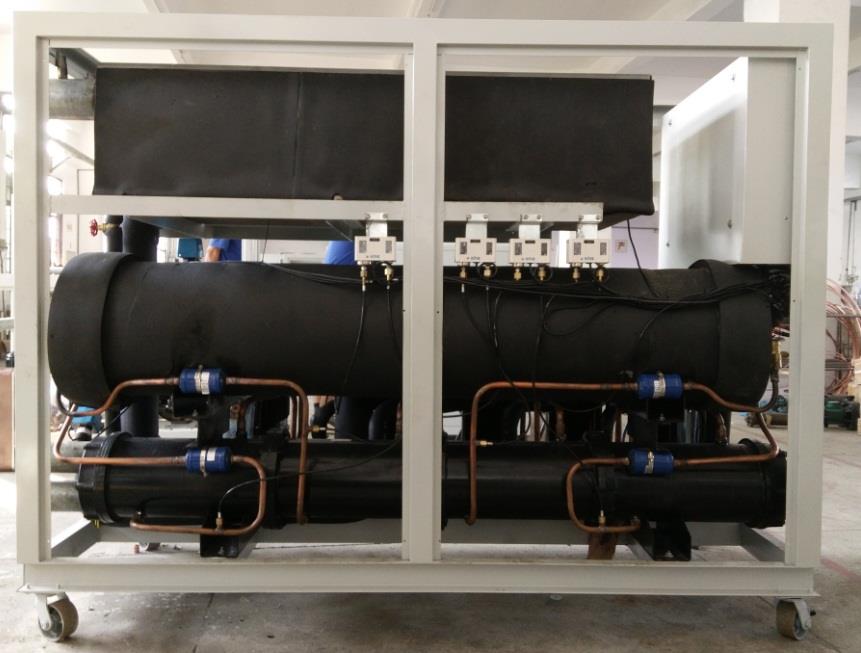
Structure of 40hp 30ton Water Cooled Water Chiller


FAQ
1. How to choose the right cooling capacity for water chiller?
Heat Load= C(specific heat)* M(quality output per hour )*Temp Change(T1-T2)
If take water’s specifications to the formula, then we could get
Cooling Capacity(kw)= Flow Rate(m3/h)*Temp Change(T1-t2)/0.86
So here we simply see that we need to see the water flow, water temp inlet, water temp outlet and whether you need to considerate 10% or 20% as backup.
2. What else should I notice after confirming the cooling capacity of chiller?
Other important chiller specifications include the power supply, water pump, the water connection size, refrigerant, and the evaporator type, tank and so on.
2.1 Power Supply
Power supply is different for different countries , the common power supplies are 208-230V, 380-420V,440-480V,50Hz or 60Hz, 3phase.
2.2 Water Pump
When you confirmed the chiller size, normally we will equip an water pump based on water flow for 5C temp difference and 2bar pressure.If need bigger pressure pls inform us additionally.
2.3 Connection Size
This usually depends on the water flow rate. If you want your new chiller to match your old pipes,pls confirm with us whether can be customize accordingly.
2.4 Refrigerant
R22, R410A, R407C, R404A, R134A are optional choices.
R22: good cooling effect, but R22 is considered a powerful greenhouse gas, so it’s forbidden in most countries.
R410A: eco-friendly, R-410A has replaced R-22 as the preferred refrigerant for use in residential and commercial air conditioners in Japan, Europe, and the United States. R-410A operates at higher pressures than other refrigerants.
R407C: a good replacement for R22, good cooling effect.
R404A: suitable for application that requires low temperature(below -30°c).
R134A: a non-flammable gas used primarily as a “high-temperature” refrigerant, suitable for air-cooled chiller working at a high ambient temperature.
2.5 Evaporator Choose
Normally there are two types of evaporators.
1.Shell and tube type evaporator, which requires an additional water buffer tank to use(not necessary but highly recommended).
2.Cooling coil tank
which has a built-in water storage tank for more convenient use. So there’s no need for extra buffer tanks, but higher maintenance.
These two evaporator coils can be made of 2 materials, copper or stainless steel tube.
What is the difference between these 2 options?
Copper tube: better heat transfer efficiency.
Stainless steel tube (304 or 316): also known as food-grade material, it is suitable for the food/beverage industry and can avoid water contamination.
3.Why choose us?
1.15years+ professionally experienced chiller R&D team,
2.Strict quality testing
3.In time and safety delivery
4.Prompt after sale service
Hot Tags: 40hp 30ton plastic injection molding extrusion bottle blowing machine chiller China, manufacturers, plant, price, for sale