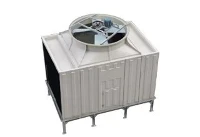
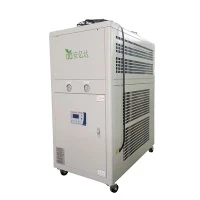
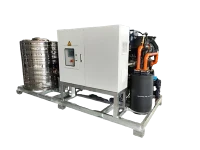
A falling film water chiller is a type of heat exchanger that uses a thin film of water to transfer heat from a refrigerant to water or another fluid. It operates on the principle of a falling liquid film that flows downward over a heat exchange surface, providing efficient cooling.
Here's how a falling film water chiller typically works:
Refrigerant Evaporation: The process starts with the evaporation of a low-pressure refrigerant, such as R134a or R410a, in the evaporator section. The refrigerant absorbs heat from the fluid that needs to be chilled, causing it to evaporate.
Film Formation: The chilled fluid enters the chiller and flows down over a series of tubes or plates within the evaporator. The design of the chiller encourages the fluid to spread out into a thin film as it moves downward due to gravity.
Heat Transfer: As the refrigerant evaporates inside the tubes or plates, it transfers heat to the thin film of fluid on the outside. The heat exchange occurs through the walls of the heat transfer surface, where the temperature difference between the refrigerant and the fluid drives the heat transfer process.
Cooling Effect: The falling film design allows for a large heat transfer area, resulting in efficient cooling of the fluid. The chilled fluid exits the chiller at a lower temperature, ready for use in various cooling applications.

Specifications of 1750kw falling film water chiller:
|
Item |
Specification / Supplier |
||
|
Cooling capacity |
Model |
AYD-1800WS |
|
|
kw/h |
1800 |
||
|
Power input |
kw |
342.4 |
|
|
Max Current |
A |
574.8 |
|
|
Power Supply |
400V-3N-50HZ |
||
|
Temp Outlet (℃) |
10 |
||
|
refrigerant control |
Expansion valve |
||
|
Refrigeration circle |
two |
||
|
refrigerant |
R407C |
||
|
Dimension(mm)L*W*H |
5500*1200*1800 |
||
|
Compressor |
style |
Semi-hermetic Screw |
|
|
Model |
RC2-790B |
||
|
Quantity(pcs) |
2 |
||
|
Compressor power(kw/ pcs) |
171.2*2 |
||
|
Condenser |
Style |
Shell and Tubes/ 2sets |
|
|
Chilled water flow(m3/h) |
350 |
||
|
Pipe size(“) |
10 |
||
|
Evaporator |
Style |
Falling Film / 2sets |
|
|
Cold water flow(m3/h) |
303 |
||
|
Pipe size(”) |
10 |
||
|
Protector Device |
1、Phase protector 2、Fan overload protector 3、High/low voltage protector 4、Coil overheat protector 5、Anti-freeze protector |
||
|
Unit Weight(kg) |
4750 |
||
|
Main Parts Brand |
|||
|
Compressor |
Hanbell |
||
|
Electronic |
LS / Carlo |
||
|
Electromagnetically valve |
Emerson |
||
|
Expansion Valve |
Emerson |
||
|
Electrical Control |
Siemens |
||

Advantages of Falling Film Water Chillers:
High Efficiency: Falling film water chillers offer high heat transfer coefficients due to the large surface area available for heat exchange. This leads to efficient cooling performance.
Energy Efficiency: The design of falling film chillers enables them to operate with lower refrigerant pressures, reducing the energy consumption required for refrigeration.
Compact Design: Falling film water chillers typically have a compact and space-saving design, making them suitable for installations with limited space.
Scalability: These chillers can be easily scaled up or down to meet specific cooling requirements by adding or removing heat exchange sections.
Reduced Fouling: The falling film design helps minimize fouling or scaling on the heat transfer surface, resulting in longer intervals between maintenance and cleaning.

Compared to Standard Water Chillers:
Standard water chillers, such as shell-and-tube or plate heat exchanger chillers, differ from falling film water chillers in their heat transfer mechanisms.
In a standard water chiller, the fluid being cooled typically flows through tubes or channels, while the refrigerant flows over the outside of these tubes or channels. Heat exchange occurs through the walls of the tubes or plates, with the fluid and refrigerant remaining separate.
In contrast, falling film water chillers have a falling liquid film on the outside of the heat exchange surface, which promotes efficient heat transfer between the refrigerant and the fluid being cooled.
Usage and Applications:
Falling film water chillers find applications in various industries where cooling is required, including:
HVAC Systems: Falling film water chillers are commonly used in large-scale commercial and industrial HVAC systems for cooling water or air.
Process Cooling: These chillers are employed in industries such as food and beverage, pharmaceuticals, chemical processing, and plastic manufacturing to cool process fluids and equipment.
Data Centers: Falling film water chillers are used to cool the IT equipment and maintain optimal temperatures in data centers, where efficient cooling is crucial for performance and reliability.
Power Generation: They are utilized in power plants to cool turbine condensers, ensuring the efficiency of power generation processes.
In summary, falling film water chillers utilize a falling liquid film to transfer heat efficiently from a refrigerant to a fluid. Their advantages include high efficiency, energy efficiency, compact design, scalability, and reduced fouling.
FAQ:
1. How can I verify the model and receive the offer?
We need to see cooling capacity, outlet temp, refrigerant and power supply.
If you are not sure about the cooling capacity, here is the formular= water flow* (temp inlet-temp outlet)/0.86
2. What is the delivery time of the falling film water chiller?
25-35 working days
3. What is the warranty ?
1year. Duraing this period, If any parts malfunction within this time, we will send you a replacement part at no additional cost for express shipping.
4. Where is your factory located?
Pingshan district, Shenzhen, Guangdong, China

Hot Tags: falling film water chiller 1800kw China, manufacturers, plant, price, for sale