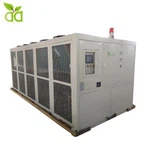
What to do if there is scale in the industrial refrigerator?
There are three circulation systems in industrial refrigeration units. Different circulation systems are prone to scale problems, such as refrigeration circulation systems, water circulation systems, and electronically controlled circulation systems. Different circulation systems require tacit cooperation to achieve the purpose of stable work.
Therefore, it is necessary to keep each system within the normal working range. Although the performance of various industrial refrigerator equipment produced in China is relatively stable, if the necessary maintenance and maintenance are not carried out for a long time, it will inevitably lead to a large number of scale problems. It not only leads to the blockage of the equipment, but also affects the water flow of the equipment.
It has a serious impact on the overall performance of the industrial refrigeration unit, and even shortens the overall life of the industrial refrigeration unit. Therefore, it is very important for the industrial refrigeration unit to clean up the scale in time.
1. Why does scale appear in the refrigerator?
The main components of scaling in the cooling water system are calcium salts and magnesium salts, and their solubility decreases with the increase of temperature; when the cooling water is in contact with the surface of the heat exchanger, scaling deposits on the surface of the heat exchanger.
Refrigerator scaling has the following four situations:
(1) Crystallization of salts in multi-component staged supersaturated solutions.
(2) Deposition of organic colloids and mineral colloids.
(3) Bonding of solid particles of certain substances with different degrees of dispersion.
(4) Electrochemical corrosion of certain substances and microbial production, etc. The precipitation of these mixtures is a major factor in fouling, which produces solid phase precipitation under the condition that the solubility of certain salts decreases with increasing temperature. Such as Ca(HCO3)2, CaCO3, Ca(OH)2, CaSO4, MgCO3, Mg(OH)2, etc. Second, as the water evaporates, the concentration of dissolved salts in the water increases, reaching a degree of supersaturation. The heated water produces chemical reactions, or some ions form other insoluble salt ions.
Some salts with the above conditions first deposit original buds on the metal surface, and then gradually become particles. It has amorphous or latent crystalline structure, and aggregates with each other to form crystals or agglomerates. Calcium bicarbonate salts are the main factors causing scaling in cooling water. This is because calcium bicarbonate loses its balance during heating and decomposes into calcium carbonate, carbon dioxide and water. Calcium carbonate, on the other hand, is less soluble and deposits on the surfaces of cooling equipment. which is:
Ca(HCO3)2=CaCO3↓+H2O+CO2↑.
The formation of scale on the surface of the heat exchanger will corrode the equipment and shorten the service life of the equipment; secondly, it will hinder the heat transfer of the heat exchanger and reduce the efficiency.
2. Removal of scale of refrigerator
1. Classification of descaling methods
The methods of removing scale on the surface of heat exchangers include manual descaling method, mechanical descaling method, chemical descaling method and physical descaling method.
Among various descaling methods. The physical descaling and anti-scaling method is ideal, but due to the working principle of the ordinary electronic descaling instrument itself, there are also situations where the effect is not ideal, such as:
(1). The water hardness varies from place to place.
(2). The water hardness of the unit varies during work, and the Light Rain electronic descaling instrument can formulate a more appropriate descaling plan based on the water samples mailed by the manufacturer, so that descaling no longer has to worry about other effects;
(3). If the operator ignores the sewage work, the surface of the heat exchanger will still be fouled.
The chemical descaling method can only be considered when the heat exchange effect of the unit is poor and the scaling is serious, but it has an impact on the equipment, so it is necessary to prevent damage to the galvanized layer and affect the service life of the equipment.
2. Sludge removal method
Sludge is mainly composed of bacteria, algae and other microbial groups dissolved and reproduced in water, mixed with mud, sand, dust, etc. to form ooze-like turbidity. It can cause pipe corrosion, reduce efficiency and increase flow resistance, reducing water volume. There are various treatment methods. The suspended matter in the circulating water can be condensed into loose alums by adding a coagulant, which is precipitated at the bottom of the sump and discharged through sewage; the suspended particles can be dispersed in the water by adding a dispersant without sinking; The formation of sludge can be inhibited by adding side filtration or by adding other drugs to inhibit or kill microorganisms.
3. Corrosion descaling method
Corrosion is mainly due to sludge and corrosion products sticking on the surface of the heat transfer tube, forming an oxygen concentration battery and corroding. Due to the progress of corrosion, the heat transfer tube is damaged and the unit has a serious failure, the cooling capacity is reduced, or even serious, The unit may be scrapped, causing the user to bear great economic losses. In fact, in the operation of the unit, as long as the water quality is effectively controlled, the management of water quality is strengthened, and the formation of dirt is prevented, the impact of corrosion on the water system of the unit can be well controlled.
When the scale increases and cannot be treated by ordinary methods, physical descaling equipment can be installed to perform scale inhibition and descaling operations, such as electronic descaling instruments, magnetic resonance ultrasonic descaling equipment, etc.
After the scale, dust and algae are attached, the heat transfer performance of the heat transfer tube drops sharply, which reduces the overall performance of the unit.
To prevent scaling and freezing of the refrigerant water in the evaporator during operation, the refrigerant water system has two types: open circulation and closed circulation. We generally use closed circulation. Because it is a sealed circuit, evaporation and concentration will not occur. At the same time, atmospheric The sediment, dust, etc. will not be mixed into the water, and the scaling of the refrigerant water is relatively slight, mainly considering the freezing problem of the refrigerant water. The water in the evaporator freezes because the heat taken away by the refrigerant when evaporating in the evaporator is greater than the heat provided by the refrigerant water flowing through the evaporator, so that the temperature of the refrigerant water drops below the freezing point, causing the water to freeze. Operators should pay attention to the following points during operation:
1. Whether the flow rate entering the evaporator is consistent with the rated flow rate of the main engine, especially if multiple refrigeration units are used in parallel, whether there is an imbalance in the amount of water entering each unit, or when the unit and the pump are running one-to-one, whether the water flow changes from the other. A unit split phenomenon. At present, the manufacturers of bromine coolers mainly use the water flow switch to judge whether there is water inflow. The selection of the water flow switch must match the rated flow, and the qualified units can be equipped with a dynamic flow balance valve.
2. The main unit of the bromine cooler is set with a low temperature protection device for the refrigerant water. When the temperature of the refrigerant water is lower than +4℃, the main engine stops running. When the operator runs for the first time in summer every year, he must check whether the low temperature protection of the refrigerant water works and whether the temperature setting value is accurate.
3. During the operation of the whole bromine cooler air conditioning system, when the water pump suddenly stops running, the main engine should be stopped immediately. If the water temperature in the evaporator still drops rapidly, measures should be taken. The refrigerant water outlet valve of the evaporator can be closed, and the drain valve of the evaporator can be properly opened to make the water flow in the evaporator and prevent the water from freezing.
4. When the bromine chiller unit stops running, it should be carried out according to the operating procedures, first stop the main engine, wait for more than ten minutes, and then stop the refrigerant water pump.
5. The water flow switch in the refrigeration unit and the low temperature protection of the refrigerant water shall not be removed at will.