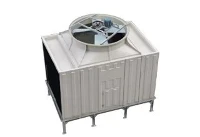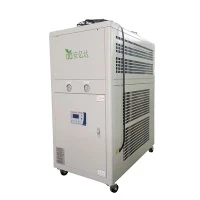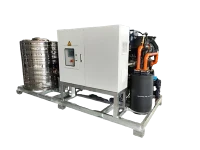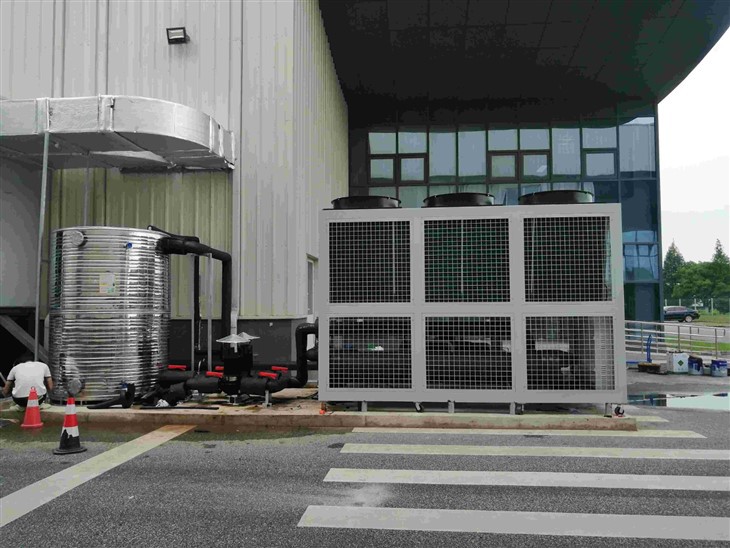
A water chiller is a refrigeration system designed to remove heat from water or any other process fluid, effectively lowering its temperature. It's utilized across various industries and applications where controlled cooling is essential, such as in industrial processes, HVAC systems, medical equipment, data centers, and laboratories.
Ⅰ.A water chiller consists of several essential components that work together to facilitate the cooling process:
1. Compressor:
Function: The compressor is the heart of the chiller. It pressurizes the refrigerant gas, raising its temperature and pressure.
Types: Reciprocating, screw, centrifugal, or scroll compressors are commonly used, each with its advantages in terms of efficiency and application.
2. Condenser:
Function: After compression, the high-pressure, high-temperature refrigerant gas flows to the condenser. Here, heat from the refrigerant is removed and dissipated to the surroundings, causing the gas to condense into a liquid.
Types: Air-cooled condensers (use ambient air) or water-cooled condensers (use water to remove heat) are the primary types.
3. Expansion Valve or Thermal Expansion Valve (TXV):
Function: The expansion valve regulates the flow of the liquid refrigerant into the evaporator. It lowers the pressure and temperature of the refrigerant as it enters the evaporator.
Types: There are different types, including thermostatic expansion valves (TEVs) and electronic expansion valves (EEVs).
4. Evaporator:
Function: In the evaporator, the low-pressure, low-temperature liquid refrigerant absorbs heat from the water (or the process fluid) circulating around it. This heat transfer causes the liquid refrigerant to evaporate into a gas.
Heat Exchange: The chilled water or process fluid gains cooling from this heat exchange process.
Types: Shell-and-tube, plate-type, or coil evaporators are commonly used designs.
5. Refrigerant:
Function: The refrigerant is the working fluid in the chiller cycle. It alternates between liquid and gas phases to absorb and release heat.
Types: Various refrigerants are used, with newer models often using environmentally friendly options due to regulations phasing out ozone-depleting substances.
6. Control Panel and Sensors:
Function: The control panel manages the chiller's operation, including temperature control, compressor operation, and safety features. Sensors monitor parameters like temperature, pressure, and flow rates for efficient functioning.
7. Pumps:
Function: Pumps circulate the chilled water or process fluid through the chiller system. They maintain consistent flow rates necessary for effective heat exchange.
Types: Centrifugal pumps or positive displacement pumps are commonly used.
8. Heat Exchangers:
Function: These transfer heat between the refrigerant and the water or process fluid. They are crucial for efficient cooling.
Types: They can be shell-and-tube, plate-and-frame, or brazed plate heat exchangers.
9. Condenser Fan or Cooling Tower (for water-cooled chillers):
Function: Air-cooled chillers use condenser fans to dissipate heat, while water-cooled chillers rely on cooling towers to reject heat into the atmosphere.
10. Insulation and Casing:
Function: To maintain efficiency and prevent heat loss, chiller components are often insulated. The outer casing protects the internal components and helps contain noise.
These components work in sync within the chiller system, ensuring the transfer of heat from the process fluid to the refrigerant and then to the surroundings, ultimately providing the required cooling effect.
Ⅱ.There are several types of water chillers, each designed with specific features and applications in mind. The main types include:
1. Air-Cooled Chillers:
Functionality: These chillers use air to remove heat from the refrigerant.
Usage: Ideal for smaller to medium-sized applications where water availability or cost of water is a concern.
Installation: Easier to install and require less maintenance than water-cooled chillers.
Location: Suited for environments with good ventilation to facilitate heat exchange.

2. Water-Cooled Chillers:
Functionality: These chillers use water to remove heat from the refrigerant.
Usage: Typically used in larger applications where water supply is ample and heat dissipation is critical.
Efficiency: More efficient than air-cooled chillers due to better heat transfer capabilities.
Space Requirement: Require more space for cooling towers and water circulation systems.
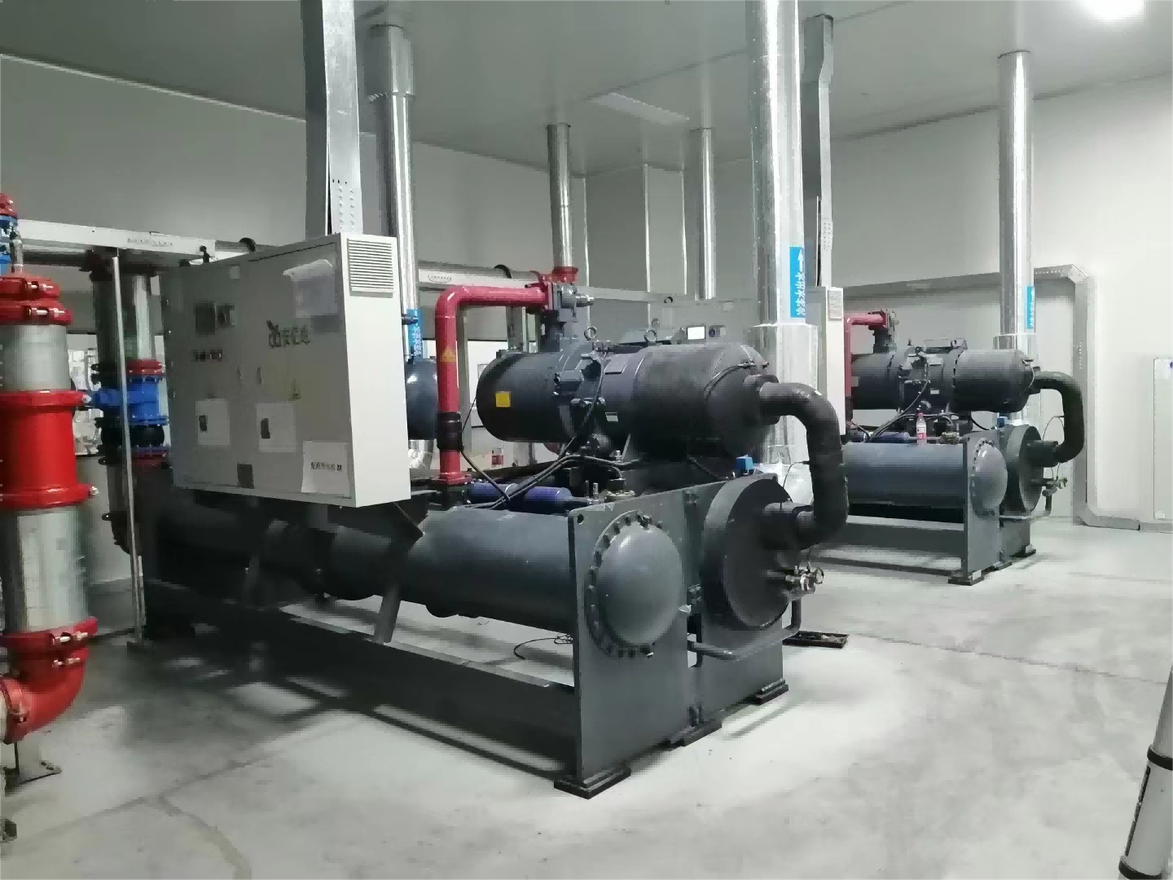
3. Absorption Chillers:
Functionality: They use heat, instead of mechanical energy, to drive the cooling process, often employing heat from steam, hot water, or combustion gases.
Usage: Commonly used in industrial and commercial settings where waste heat or excess heat is available.
Energy Source: Can be powered by natural gas, waste heat, or other energy sources, offering flexibility in operation.
4. Centrifugal Chillers:
Functionality: Operate using centrifugal force to compress refrigerant gas.
Usage: Suited for larger commercial or industrial applications requiring high cooling capacities.
Efficiency: Known for their energy efficiency at larger scales.
5. Scroll Chillers:
Functionality: Use a scroll compressor, which consists of spiral-shaped components, for compressing refrigerant gas.
Usage: Ideal for smaller applications, offering reliability and quieter operation.
Efficiency: They are efficient at part-load conditions.
6. Screw Chillers:
Functionality: Employ screw compressors for refrigerant compression.
Usage: Suitable for medium to large-scale applications, providing good efficiency and reliability.
Adaptability: Perform well across varying load conditions.
7. Reciprocating Chillers:
Functionality: Use reciprocating pistons to compress refrigerant gas.
Usage: Commonly found in smaller commercial applications due to their compact size.
Cost-effectiveness: Often cost-effective for smaller capacities and applications.
The choice of a specific type of water chiller depends on various factors like cooling requirements, available resources (water, space, energy), application scale, and efficiency expectations. Consulting with HVAC or chiller system specialists can help in determining the most suitable type for a particular use case.
Ⅲ.Selecting the right water chiller involves considering several key factors to ensure it meets your specific cooling needs. Here's a step-by-step guide to help in the selection process:
1. Determine Cooling Requirements:
Cooling Load: Calculate the amount of heat that needs to be removed per hour (in BTUs or tons of refrigeration). This depends on the application, space, equipment, or process requiring cooling.
Heat Load= C(specific heat)* M(quality output per hour )*Temp Change(T1-T2)
If for water, the simple formula is Cooling Capacity(kw)= Flow Rate(m3/h)*Temp Change(inlet t1-outlet t2)/0.86
Here some cooling capacity unit conversion?
1 kcal/h = 1.163W, 1 W = 0.8598 kcal/h
1 Btu/h = 0.2931W,1 W = 3.412 Btu/h
1 RT = 3.517 kW, 1 kW = 0.28434 RT
1 kcal/h = 3.968 Btu/h, 1 Btu/h = 0.252 kcal/h
1 USRT = 3024 kcal/h, 10000 kcal/h = 3.3069 RT
|
Item |
Specification / Supplier |
||
|
Cooling capacity |
Model |
AYD-130A |
|
|
kw/hr |
289.9 |
||
|
Power input |
kw |
134.2 |
|
|
Current |
A |
241.56 |
|
|
Power Supply |
380V-3N-50HZ |
||
|
Temp Outlet (℃) |
2 |
||
|
refrigerant control |
Expansion valve |
||
|
Refrigeration circle |
one |
||
|
refrigerant |
R407C |
||
|
Dimension(mm)L*W*H |
5000*2000*2200 |
||
|
Compressor |
Style |
Screw |
|
|
Quantity(set) |
1 |
||
|
Compressor Power(kw) |
115.7 |
||
|
Condenser |
Style |
Fin type with copper coil |
|
|
Quantity(set) |
10 |
||
|
Power(kw) |
11 |
||
|
Air Volume(m3/h) |
130000 |
||
|
Evaporator |
Style |
Shell and Tubes |
|
|
Cold water flow(m3/h) |
50 |
||
|
Pipe size(DN) |
100 |
||
|
Water Pump(kw) |
7.5(60m3/h, 2.36bar) |
||
|
Protector Device |
1.Phase protector 2.Fan overload protector 3.High/low voltage protector 4.overheat protector 5.Anti-freeze protector |
||
|
Unit Weight(kg) |
3980 |
||
|
Main Parts |
|||
|
Compressor |
Hanbell |
||
|
Condenser |
Anyda |
||
|
Evaporator |
Jindian |
||
|
Electronic |
LS/ Chnt |
||
|
Expansion Valve |
Emerson |
||
|
Control System |
Pun |
||
Remarks: The cooling capacity is based on ambient temp 35C, inlet/outlet temp 7/2C.

2. Understand Application Specifics:
Temperature Range: Define the required temperature range for the application.
We need to confirm the condenser area size, higher temperature outlet the condenser heat exchange are is bigger.
Operating Conditions: Consider the environment, humidity levels, and any specific operational needs.
For example,if the water chiller is working near by sea, the sea air is corrosive, we need to make anti-corrosive painting for frame and condensers,adopt FPR fan and so on.
Space Constraints: Assess available space for installation—whether it suits an air-cooled or water-cooled chiller and the associated components.
3. Energy Efficiency:
Energy Consumption: Look for chillers with high Energy Efficiency Ratios (EER) or Coefficient of Performance (COP) to minimize operational costs.
Variable Speed Drives (VSD): Consider chillers equipped with VSD technology for better efficiency at varying loads.
4. Type of Chiller:
Air-Cooled vs. Water-Cooled: Decide between air-cooled and water-cooled chillers based on water availability, space, and cost considerations.
Specific Chiller Type: Consider absorption, centrifugal, screw, scroll, or reciprocating chillers based on the application size, efficiency needs, and load variations.
5. Maintenance and Support:
Maintenance Requirements: Evaluate the ease of maintenance, availability of spare parts, and service support.
Warranty and Support: Ensure the manufacturer provides reliable warranty coverage and responsive support.
6. Budget Considerations:
Initial Cost vs. Long-Term Expenses: Balance upfront costs with long-term operational expenses to determine the most cost-effective solution.
Return on Investment (ROI): Consider the potential savings in energy costs and increased efficiency to assess the ROI of the chiller.
7. Consultation and Analysis:
Expert Opinion: Consult with HVAC engineers or chiller system experts to analyze your specific requirements and recommend suitable options.
Technical Specifications: Review detailed technical specifications, including capacity, efficiency ratings, and performance data provided by manufacturers.
8. Environment and Regulations:
Environmental Impact: Consider environmental regulations and opt for chillers with eco-friendly refrigerants compliant with current standards.
Local Codes and Standards: Ensure the selected chiller meets local building codes and standards.
Ⅳ.Water chillers find application across a diverse range of industries and sectors due to their ability to efficiently cool water or process fluids. Some of the primary applications include:
1. Industrial Processes:
Manufacturing: Cooling machinery, molds, and products in industries like plastics, rubber, metalworking, and textiles.
Chemical Processing: Controlling temperatures in various chemical reactions and processes.
Food and Beverage: Maintaining consistent temperatures in food processing, beverage production, and storage facilities.
2. HVAC Systems:
Commercial Buildings: Providing chilled water for air conditioning systems to regulate indoor temperatures.
Residential Cooling: In high-rise buildings and residential complexes for centralized cooling systems.
3. Medical and Laboratory Equipment:
Medical Imaging: Cooling MRI machines and other medical imaging equipment to maintain optimal functionality.
Laboratory Settings: Keeping laboratory equipment and processes at precise and stable temperatures for experiments and research.
4. Data Centers and Electronics:
Server Rooms: Cooling servers and electronic equipment in data centers to prevent overheating and ensure optimal performance.
Electronics Manufacturing: Cooling electronic components during production processes to maintain functionality and prevent damage due to high temperatures.
5. Plastics and Injection Molding:
Injection Molding Machines: Cooling molds to facilitate the solidification of molten plastic and improve production efficiency and product quality.
6. Energy Generation and Power Plants:
Power Generation: Cooling systems in power plants to manage heat generated during energy production processes, such as in gas turbines or nuclear reactors.
7. Printing Industry:
Printing Presses: Cooling rollers and equipment in printing processes to maintain print quality and prevent overheating.
8. Chemical and Pharmaceutical Industries:
Biotechnology and Pharmaceuticals: Maintaining controlled temperatures in research, production, and storage of sensitive materials like vaccines and pharmaceuticals.
9. Aerospace and Automotive Industries:
Manufacturing: Cooling various components during manufacturing processes to ensure precise dimensions and material properties.
10. Beverage Dispensing and Refrigeration:
Beverage Dispensers: Cooling beverages in dispensing machines and refrigeration units for bars, restaurants, and convenience stores.
Water chillers play a crucial role in maintaining consistent temperatures, enhancing process efficiency, preserving product quality, and ensuring the smooth operation of various equipment and systems across these diverse industries and applications.
Company Introduce:
Shen Zhen Anyda Refrigeration Machinery Co., Ltd. is a high-tech private enterprise which was established in 2013,with the registered capital of 5 million yuan, covers an area of 8900 square meters, Anyda gradually grow up step by step.
Anyda is specialized in the research, production and trading of industrial refrigeration technology and facilities. We have gradually produced Industrial Chiller,Water Chiller,Air Cooler,Oil Chiller,Low Temperature Chillers,Hot Water Chiller, Heat Pumps and Central Air Conditioner which are widely applied to plastic & rubber machinery, daily-use chemical, textile, general machinery, laser machinery, LCD and PCB industry, electroplating, equipments of laboratory, food, pharmacy, etc .
Now we own almost one hundred staff and about five of them are engineers with 15years of chiller R & D and production management manufacturing experience which provide the best technical support to our customer.
We gained the certification of ISO9001:2008 and CE international quality management systems. We have exported to Russia,Uzbekistan,Kazakhstan,Saudi Arabia,Africa,Indonesia,Malaysia,Romania,Bulgaria,Australia,Palestine,SriLanka,Mexico,Amercia,Lebanon ,Lithuania and so on,which covered about USD2millions.We are looking forward to your suggestion, and are confident of becoming your choice!

FAQ:
Q1: How do I maintain an industrial water chiller?
A1: Proper maintenance is crucial to ensure the optimal performance and longevity of your industrial water chiller. Regular maintenance tasks include cleaning or replacing air filters, checking refrigerant levels and pressures, inspecting electrical connections, cleaning condenser coils, lubricating moving parts, and scheduling professional inspections. Consult the manufacturer's guidelines and maintenance manuals for detailed instructions.
Q2: How long does an industrial water chiller typically last?
A2: The lifespan of an industrial water chiller can vary depending on factors such as usage, maintenance practices, and the quality of the equipment. However, with regular maintenance and proper care, an industrial water chiller can last between 15 to 25 years or more.
Q3: Can industrial water chillers be energy-efficient?
A3: Yes, industrial water chillers can be designed to be energy-efficient. Many manufacturers offer chiller models with advanced features such as variable speed drives, energy-efficient compressors, heat recovery options, and intelligent control systems. These features help optimize energy consumption and reduce operating costs.
Q4: Can industrial water chillers be connected to a centralized control system?
A4: Yes, most modern industrial water chillers can be integrated into centralized control systems. This allows for remote monitoring and control of multiple chillers, enabling better management of cooling processes, energy efficiency, and diagnostics.
Q5: What is the HS code of the water chiller?
A5: 8418699090.
Hot Tags: water chiller for water cooling China, manufacturers, plant, price, for sale