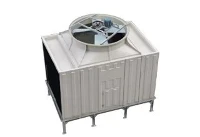
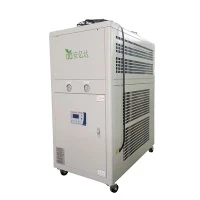
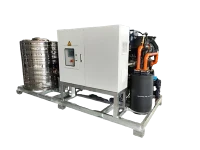
A water chiller system provides consistent temperature and pressure to your industrial process. Eliminating temperature and pressure variables simplifies the process development and optimization, ensuring the highest quality product. Instead of a wasteful, single-pass-through system, a chiller recirculates the cooling water. The recirculation minimizes the cost of water consumption which can be expensive and environmentally unfriendly.
How does a Chiller Work?
In most process cooling applications, a pumping system circulates cool water or a water/glycol solution from the chiller to the process. This cool fluid removes heat from the process and the warm fluid returns to the chiller. The process water is the means by which heat transfers from the process to the chiller.
Process chillers contain a chemical compound, called a refrigerant. There are many types of refrigerant and applications depending on the temperatures required but they all work on the basic principle of compression and phase-change of the refrigerant from a liquid to a gas and back to a liquid. This process of heating and cooling the refrigerant and changing it from a gas to a liquid and back again is the refrigeration cycle.
The refrigeration cycle starts with a low-pressure liquid/gas mix entering the evaporator. In the evaporator, heat from the process water or water/glycol solution boils the refrigerant, which changes it from a low-pressure liquid to a low-pressure gas. The low-pressure gas enters the compressor where it is compressed to high-pressure gas. The high-pressure gas enters the condenser where ambient air or condenser water removes heat to cool it to a high-pressure liquid. The high-pressure liquid travels to the expansion valve, which controls how much liquid refrigerant enters the evaporator, thereby beginning the refrigeration cycle again.
There are two types of condensers used in chillers: air-cooled and water-cooled. An air-cooled condenser uses ambient air to cool and condense the hot refrigerant gas back down to a liquid. It can be located inside the chiller or can be remotely located outside, but ultimately it rejects the heat from the chiller to the air. In a water-cooled condenser, water from a cooling tower cools and condenses the refrigerant.If condensers and evaporator are separated and connect by copper pipe, then it is split water chiller system.
Split air-cooled chillers are made up of 2 main components. The first component is an air-cooled condenser unit, which is typically installed outdoors in order to dissipate the heat to the atmosphere. The second component is the Heat Transfer Pump Tank Skid, which is typically installed indoors. The Heat Transfer Pump Tank Skid contains evaporator(s), refrigerant liquid and suction line components, water/glycol reservoir, and pumps. One pump (chiller circulation pump) circulates the chiller’s evaporator to keep the chiller system’s reservoir tank at the target set point temperature. The other pump (process supply pump) pulls out of the chiller’s internal reservoir, circulates to your downstream application, and returns back to the chiller’s internal reservoir.
If you are considering a split chiller for your application environment, here are three benefits for these systems:
1.No Freeze Protection Required – With an indoor evaporator, there is no need to deploy the freeze protection strategies normally associated with outdoor units, including using glycol, drain systems, and running pumps throughout the winter.
2.Reduced Noise – The indoor condenser in traditional air-cooled chillers can produce higher noise levels due to the use of cooling fans. The outdoor condenser of a split chiller will reduce the volume in the room, making it ideal for noise-sensitive environments.
3.Extended Lifespan – Whenever components of an industrial chiller are installed outdoors (where they are exposed to the elements), the lifespan of the equipment will be shortened. With an indoor evaporator and compressor, an air-cooled split chiller may last longer than a traditional packaged air-cooled system with all components outdoors.
4.Room saved –When the application environment cannot accommodate packaged air-cooled or water-cooled industrial chillers, an air-cooled split chiller may be the ideal solution for your industrial cooling needs.
Item | Specification / Supplier | ||
Cooling capacity | Model | AYD-20A | |
kw | 50.96 | ||
Power input | kw | 20.84 | |
Power Supply | 380V-3N-50HZ | ||
Temp Outlet (℃) | 7 | ||
refrigerant control | Expansion valve | ||
Refrigeration circle | two | ||
refrigerant | R22 | ||
Dimension(mm)L*W*H | 1950*910*1700 | ||
Compressor | Style | Scroll | |
Quantity(set) | 2 | ||
Compressor Power(kw) | 16.9 | ||
Condenser | Style | Fin type with copper coil | |
Fan Quantity(set) | 2 | ||
Air Volume(m3/h) | 21000 | ||
Evaporator | Style | Shell and Tubes | |
Cold water flow(m3/h) | 10.16 | ||
Pipe size(DN) | 50 | ||
Water Pump(kw) | 1.5(11m3/h,2bar) | ||
Water Tank(L) | 200 | ||
Protector Device | 1.Phase protector 2.Fan overload protector 3.High/low voltage protector 4.overheat protector 5.Anti-freeze protector | ||
Unit Weight(kg) | 790 | ||
Main Parts | |||
Compressor | Sanyo | ||
Condenser | Anyda | ||
Evaporator | Jindian | ||
Electronic | LS/ Chnt | ||
Expansion Valve | Emerson | ||
Pump | Mina | ||
Control System | Punp | ||
Remarks: The cooling capacity is based on condensing temp 50C, inlet/outlet temp 12/7C.
RFQ:
1. When your company establish?
Year 2013, but our team engaged in this industry from 2007.
2. How to choose the right cooling capacity for an air-cooled chiller?
Heat Load= C(specific heat)* M(quality output per hour )*Temp Change(T1-T2)
If take water’s specifications to the formula, then we could get
Cooling Capacity(kw)= Flow Rate(m3/h)*Temp Change(T1-t2)/0.86
So here we simply see that we need to see the water flow, water temp inlet, water temp outlet and whether you need to considerate 10% or 20% as backup.
3.What else should I notice after confirming the cooling capacity of chiller?
Other important chiller specifications include the power supply, water pump, the water connection size, refrigerant, and the evaporator type, tank and so on.
3.1 Power Supply
Power supply is different for different countries , the common power supplies are 208-230V, 380-420V,440-480V,50Hz or 60Hz, 3phase.
3.2 Water Pump
When you confirmed the chiller size, normally we will equip an water pump based on water flow for 5C temp difference and 2bar pressure.If need bigger pressure pls inform us additionally.
3.3 Connection Size
This usually depends on the water flow rate. If you want your new chiller to match your old pipes,pls confirm with us whether can be customize accordingly.
3.4 Refrigerant
R22, R410A, R407C, R404A, R134A are optional choices.
R22: good cooling effect, but R22 is considered a powerful greenhouse gas, so it’s forbidden in most countries.
R410A: eco-friendly, R-410A has replaced R-22 as the preferred refrigerant for use in residential and commercial air conditioners in Japan, Europe, and the United States. R-410A operates at higher pressures than other refrigerants.
R407C: a good replacement for R22, good cooling effect.
R404A: suitable for application that requires low temperature(below -30°c).
R134A: a non-flammable gas used primarily as a “high-temperature” refrigerant, suitable for air-cooled chiller working at a high ambient temperature.
3.5 Evaporator Choose
Normally there are two types of evaporators.
1.Shell and tube type evaporator, which requires an additional water buffer tank to use(not necessary but highly recommended).
2.Cooling coil tank which has a built-in water storage tank for more convenient use. So there’s no need for extra buffer tanks, but higher maintenance.
These two evaporator coils can be made of 2 materials, copper or stainless steel tube.
What is the difference between these 2 options?
Copper tube: better heat transfer efficiency.
Stainless steel tube (304 or 316): also known as food-grade material, it is suitable for the food/beverage industry and can avoid water contamination.
Hot Tags: split air water chiller system China, manufacturers, plant, price, for sale