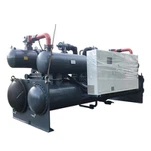
Why does the plate heat exchanger of industrial chillers always freeze out in winter?
The production and processing technology of plate heat exchangers has become more mature and can be mass-produced. Compared with other heat exchangers, they have the advantages of compact structure, light weight, small space, and high heat exchange value in specific applications. They are often used in the industrial refrigeration industry. As a condenser or evaporator, it is an indispensable part of the refrigeration industry.
However, if the plate heat exchanger is not installed and debugged in accordance with the assembly operation and maintenance guidelines given by the manufacturer during installation and commissioning, it will be frozen when the water quality is poor or the water flow is too low. Break the situation.
From the design of refrigeration unit control system, distributor production and manufacturing, and processing plant production, the end customer uses these levels to analyze the reasons for plate replacement icing and leakage, and provide corresponding solutions.
1. In industrial refrigeration, the inlet temperature of the refrigerant in the saturated state is too low. The saturation temperature is the temperature value that the liquid and refrigerant need to have when they are in equilibrium, that is, saturated. When the plate is used as an evaporator in the refrigeration unit, the refrigerant is on the plate The time for the internal saturated volatilization temperature of the replacement to be less than minus 10 degrees Celsius cannot be higher than 20 seconds, otherwise, it will cause the plate to penetrate and crack in an instant, causing the plate to leak.
2. In winter, the electric heating device of the plate heat exchanger fails, and the refrigerating unit operates less in winter. After shutting down, the refrigerated water inside the plate heat exchanger is not completely drained and clean, and it freezes when it encounters cold temperatures, resulting in plates. Freeze cracked and leaked.
There is also a situation that when customers use industrial chillers in winter, the electric heater on the surface of the plate heat exchanger will fail due to circuit failure or equipment failure. , Which in turn causes the internal freezing of the plate heat exchanger, resulting in leakage of the plate exchange, and even safety accidents.
3. The flow control valve is invalid. Generally, a flow control valve is installed on the water outlet of the refrigeration unit. The main function of the flow control valve is to monitor the flow of cold water and prevent the water flow from being too low. When the water flow is too low, the alarm device will be triggered and the shutdown will be forced, and the protection board will not be broken by freezing.
If there is a problem with the flow control valve, it must be maintained in time, otherwise it will cause a control program error. When the water flow is lower than the rated value, the alarm cannot be given in time and the shutdown is turned off, it will cause the flow rate in the plate changer to be too low, which will freeze and cause the plate changer to leak.
4. The setting parameters of the refrigeration unit are not in compliance. Before the refrigeration unit leaves the factory, it is necessary to simulate the operation of the refrigerant saturation state breathing temperature, the minimum water flow alarm value, and the test before leaving the factory. Ensure the correctness of the values.
To sum up, in fact, there are many factors that cause the freezing and cracking leakage of the refrigeration unit plate. Checking every process can solve most of the problem of freezing cracking and leakage of the floor.
Anyda reminds everyone that if you operate an industrial chiller in winter, you can install a filter at the water inlet of the plate changer, install a flow control valve at the water outlet, and equip the plate change surface of the refrigeration unit with an electric heating device to effectively prevent most The board is replaced with freeze cracking.