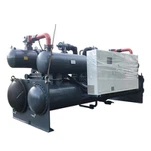
What are the condenser cleaning techniques and steps?
Cleaning the condenser on time is one of the key method steps in manufacturing. In this way, it can not only prevent the fouling from affecting the heat dissipation, improve the operation efficiency of the equipment, but also increase the life of the condenser and save costs. Therefore, the condenser cleaning can be divided into physical cleaning and chemical cleaning. Generally, high-pressure water jets are used for physical cleaning to remove the dirt from the condenser copper tubes; if the scale is hard scale, the physical method cannot be used to remove the scale, and only chemical agents are used. Carry out cleanup. In order to better ensure that the condenser is operating in good condition, it is necessary to carry out professional chemical treatment of the condenser. The following steps are the correct method:
1. Close the valve of the cooling water in and out of the condenser tightly, and use the thermometer tube, pressure gauge tube or sewage pipe to connect the anti-corrosion pump and the liquid tank to make a small circulation system and clean it cyclically.
2. Add pickling corrosion inhibitor first. This agent is a special copper corrosion inhibitor. It adheres to the metal sidewall of the condenser to avoid chemical reactions between acid and metal.
3. Then add a solid pickling cleaning agent to clean up calcium carbonate scale as the key component of the scale. The cleaning agent is a composite solid organic acid, white crystals, non-corrosive to metals, and a weak acid. The amount of cleaning agent used depends on the equipment. Depends on the amount of fouling.
4. Add mud scale stripping agent (optional). If the condenser equipment is thicker, you must add mud scale stripping agent to promote the reactant after the scale chemical reaction to quickly dissolve the water and accelerate the deep scale chemical reaction.
5. Add a neutralizing passivator, and after the condenser is chemically cleaned, it will neutralize the residual acid to prevent the metal surface from being oxidized and converted into secondary floating rust.
It is very necessary to clean the condenser immediately on time. Considering that the condenser of the chiller is very easy to foul, the daily water treatment should be strengthened during the summer cooling period. Otherwise, it will dissolve in the circulating water system when operating in a high-hardness water environment. Inorganic salts in the water will crystallize out along with the rise in temperature, and scale will be produced on the tube wall of the condenser heat exchange surface, causing the efficiency of heat exchange to decrease.